 Domain SearchInstantly check and register your preferred domain name
 Web Hosting
 cPanel HostingHosting powered by cPanel (Most user friendly)
 KE Domains
 Reseller HostingStart your own hosting business without tech hustles
 Windows HostingOptimized for Windows-based applications and sites.
 Free Domain
 Affiliate ProgramEarn commissions by referring customers to our platforms
 Free HostingTest our SSD Hosting for free, for life (1GB storage)
 Domain TransferMove your domain to us with zero downtime and full control
 All DomainsBrowse and register domain extensions from around the world
 .Com Domain
 WhoisLook up domain ownership, expiry dates, and registrar information
 VPS Hosting
 Managed VPSNon techy? Opt for fully managed VPS server
 Dedicated ServersEnjoy unmatched power and control with your own physical server.
 Website Builder
 Online Store BuilderLaunch a professional e-commerce store without writing code.
 Web Design ServiceGet a custom-designed website tailored to your brand and goals. From just KES 15,600
 BlogRead our guides on web hosting, online business, digital marketing, and more
 SupportOur support guides cover everything you need to know about our services
 ContactContact us via chat or email
The gap between open-source and proprietary AI is closing fast. GLM-5.1 is proof.
The assumption has always been that if you want the best AI output, you pay for a closed-source model from a US lab.
GLM-5.1, from Z.ai (formerly Zhipu AI), is an open-weight frontier model.
You can download it, modify it, and deploy it commercially under the permissive MIT license.
It shines in high-volume tasks and self-hosted setups.
Claude Opus 4.8, from Anthropic, launched on May 28, 2026. It remains API-only and closed-source.
Many professionals consider it one of the top models for deep reasoning and agentic coding right now.
On paper, they look like complete opposites: one free to run locally, the other premium and polished.
In workflows, the choice depends on your priorities: cost and control versus refinement and reliability.
This guide compares GLM 51 vs. Claude Opus. You will see benchmarks, pricing, writing quality, coding performance, and workflow fit.
You will also learn how Truehost OpenClaw makes self-hosting GLM-5.1 simple and affordable.
Quick Verdict Comparison Table
| Area | GLM-5.1 | Claude Opus 4.8 |
| Best for | Value-conscious teams, bulk usage, self-hosted agent builds | Premium writing, strategy, research, high-stakes outputs |
| Reasoning | Strong for most everyday work; excels at long-horizon iterative tasks | Stronger across coding, agentic tasks, and professional work |
| Coding | 58.4% SWE-Bench Pro (self-reported); better for high-volume iteration | 69.2% SWE-Bench Pro, 88.6% SWE-Bench Verified; 4× fewer unflagged code flaws |
| Writing quality | Good for blog posts, product copy, summaries | More polished and publish-ready; stronger citation precision |
| Speed | ~56 tokens/sec via most providers | Standard mode for quality; Fast Mode at 2.5× speed |
| Context window | 203K tokens | 1M tokens (Anthropic API, Bedrock, Vertex AI); 200K on Microsoft Foundry |
| Cost | ~$0.98–$1.40 input / $3.08–$4.40 output per 1M tokens | $5.00 input / $25.00 output per 1M tokens; Fast Mode at $10/$50 |
| License | MIT open-weight — download, fine-tune, deploy commercially, no restrictions | Proprietary API only; no self-hosting or fine-tuning |
| Output feel | Practical, efficient, cost-effective | More refined; better at carrying context across long sessions |
Benchmark Performance: How Do They Compare?
1) Coding & Software Engineering
This is where GLM-5.1 made its name. And where Claude Opus 4.8 reasserted dominance.
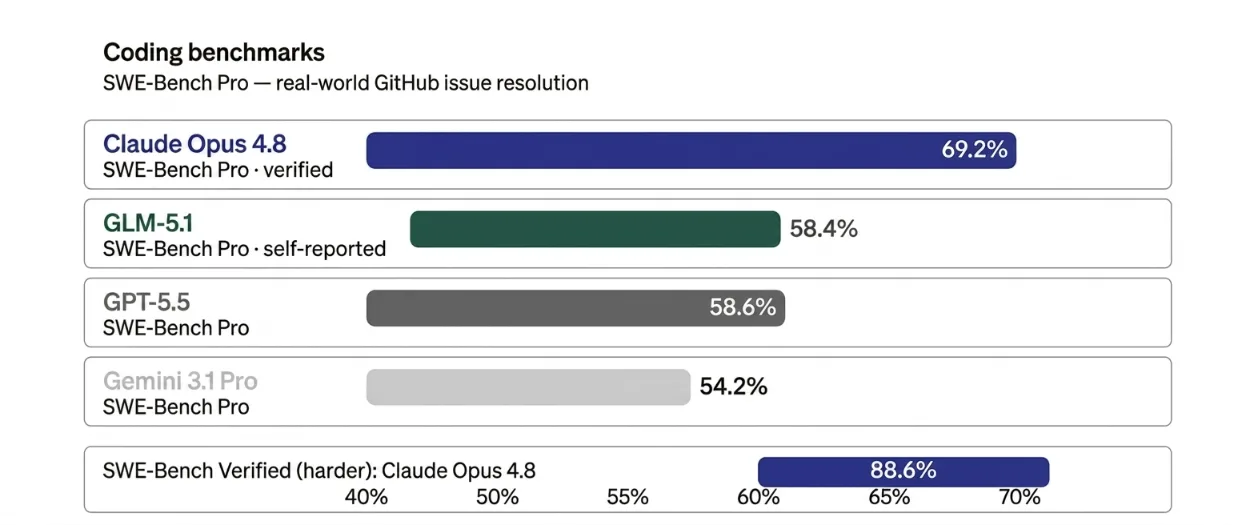
On SWE-Bench Pro, GLM-5.1 scores 58.4%. That edged out Claude Opus 4.6 when it launched in April 2026.
It was a milestone no open-weight model had led that benchmark before. There’s an important caveat, though.
Those scores are self-reported by Z.ai. Standardized independent comparisons under identical scaffolding hadn’t been published as of mid-April 2026.
Treat them as directional, not definitive.
Claude Opus 4.8 doesn’t have that problem. Opus 4.8 scores 69.2% on SWE-Bench Pro, up from 64.3% on Opus 4.7.
On SWE-Bench Verified, it hits 88.6%. That puts it 10.6 points ahead of GPT-5.5 on the harder benchmark.
One more number worth noting: Opus 4.8 is now 4× less likely than its predecessor to ship code with unflagged flaws.
For production-grade work, that’s not a minor footnote.
2) Long-Horizon & Agentic Tasks
GLM-5.1’s standout feature is endurance.
In demonstrations, the model built a complete Linux desktop system autonomously over eight hours.
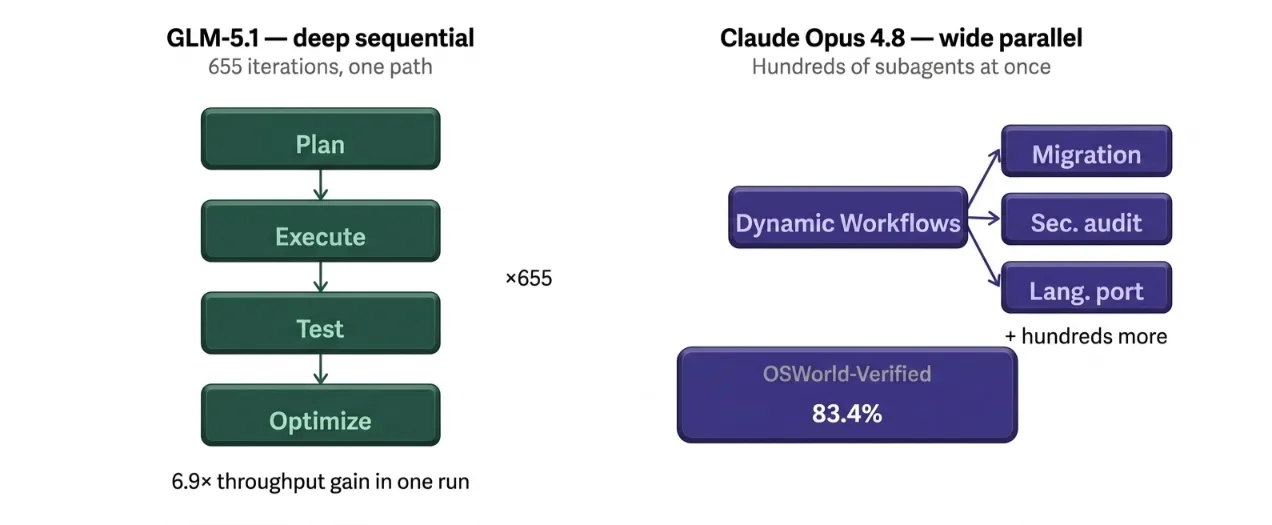
It ran 655 iterations of planning, execution, testing, and optimization.
In a separate test, it increased vector database query throughput to 6.9× the initial production baseline through iterative experimentation alone.
Claude Opus 4.8 takes a different approach. Its Dynamic Workflows feature in Claude Code spawns hundreds of parallel subagents simultaneously.
Think codebase migrations, security audits, and language ports all running in parallel rather than one step at a time.
On OSWorld-Verified for agentic computer use, Opus 4.8 scores 83.4%. GPT-5.5 comes in at 78.7%. Gemini 3.1 Pro sits at 76.2%.
Both approaches work. GLM-5.1 goes deep sequentially. Opus 4.8 goes wide in parallel.
Read also: Openclaw OpenAI Integration
3) General Knowledge & Reasoning
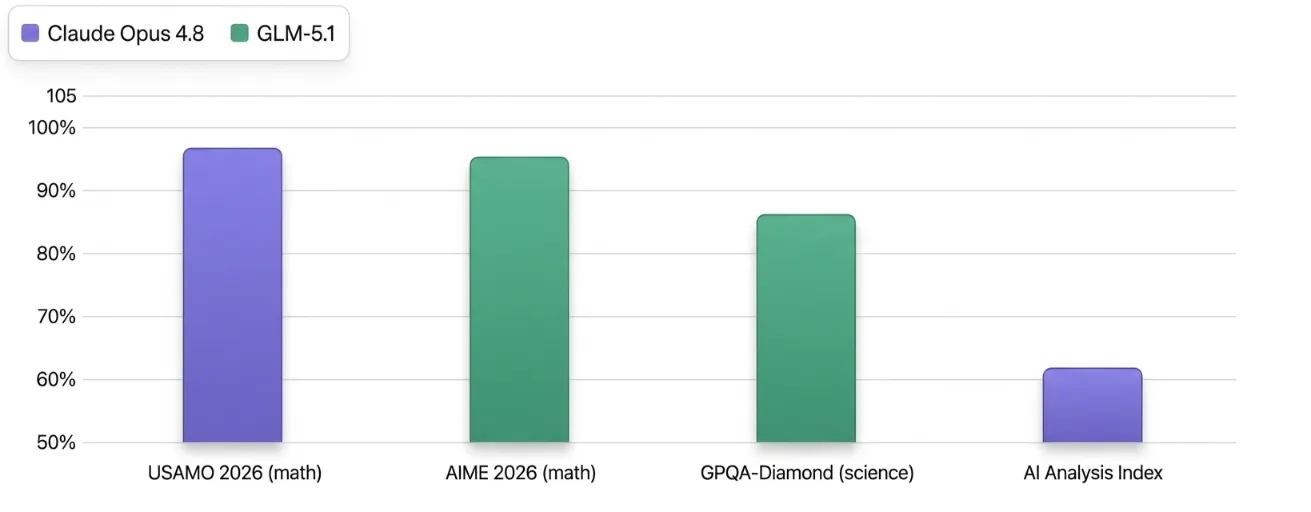
Claude Opus 4.8 scored 96.7% on the USAMO 2026 math benchmark. On Opus 4.7, that number was 69.3%.
That’s a 27.4 percentage point gain in a single 41-day release cycle. It’s the biggest single-cycle math improvement in Opus history.
On the Artificial Intelligence Index, Opus 4.8 scores 61.4. That’s the highest of any generally available model as of late May 2026.
GLM-5.1 holds its own. It scores 95.3 on AIME 2026, 82.6 on HMMT Feb. 2026, and 86.2 on GPQA-Diamond, a graduate-level science reasoning benchmark.
Competitive numbers, especially for an open-weight model you can self-host.
Pricing: Which Is Cheaper?
This is where the gap is most visible.
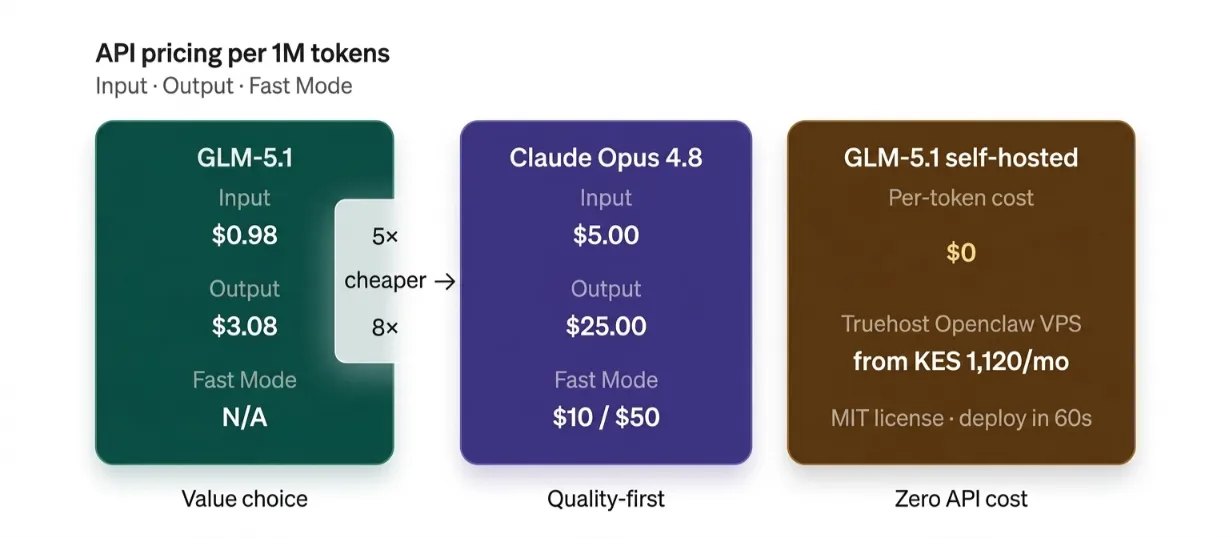
GLM-5.1 API pricing via OpenRouter starts at $0.98 per million input tokens and $3.08 per million output tokens.
Claude Opus 4.8 is priced at $5 per million input tokens and $25 per million output tokens. That’s unchanged from Opus 4.7.
Run the numbers: roughly 5× cheaper on input and 8× cheaper on output with GLM-5.1.
Claude Opus 4.8’s Fast Mode runs at 2.5× the standard speed.
It’s priced at $10/$50 per million tokens, approximately 3× cheaper than Opus 4.7’s fast mode cost.
That’s a real improvement if speed is more important than cost-per-token.
The self-hosting wildcard. GLM-5.1’s MIT license changes the equation entirely.
Run it on your own infrastructure, say, on a Truehost Openclaw VPS, and your per-token cost drops to zero.
You pay for compute, not API calls. For teams sending high volumes of prompts, that difference compounds fast.
At KES 1,120/month, Openclaw lets you deploy GLM-5.1 preconfigured with free SSL.
Live in under 60 seconds. No per-token billing. No vendor lock-in. No export control concerns.
Claude Opus 4.8 has no self-hosting path. It’s proprietary. Every prompt goes through Anthropic’s API at $25 per million output tokens.
What Are the Main Differentiators
1) Positioning
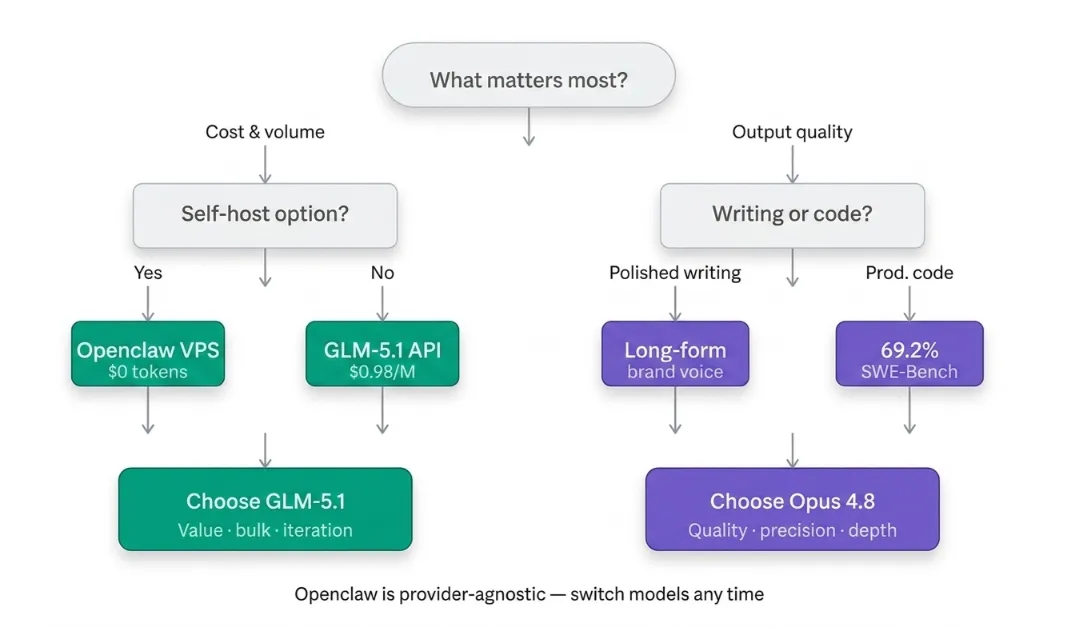
These two models aren’t competing for the same buyer.
GLM-5.1 is built for teams that want broad frontier capability without the frontier price tag.
It’s practical and flexible. Capable enough for most real-world tasks and dramatically cheaper at scale.
Claude Opus 4.8 is Anthropic’s most capable general-access model. Anthropic calls it a ‘modest but tangible improvement’ over Opus 4.7.
The benchmark numbers tell a more interesting story. The gains on agentic coding and knowledge work are real, not marginal.
It’s the quality-first option for work where the output has to be right the first time.
2) Writing Quality
GLM-5.1 handles general blog posts, product copy, and summaries well. Expect more editing for tone consistency.
Especially on longer pieces or content that needs a strong, consistent brand voice.
Claude Opus 4.8 is noticeably stronger here. Better citation precision. More consistent style across long sessions.
If you’re producing client-facing content or investor reports, Opus 4.8 reduces your editing load considerably.
3) Coding Work
GLM-5.1 is solid for everyday coding, debugging, and iteration-heavy workflows.
It becomes genuinely attractive at high prompt volumes especially when you pair it with Truehost Openclaw to eliminate per-token costs entirely.
Claude Opus 4.8 leads on every major coding benchmark. SWE-Bench Pro at 69.2%.
SWE-Bench Verified at 88.6%. It’s the better choice for architecture decisions, complex multi-file debugging, and explanation-heavy generation where you need the model to walk you through its reasoning clearly.
4) Speed and Iteration
GLM-5.1 generates output at around 56 tokens per second across providers.
That’s decent throughput for background autonomous tasks. Good for overnight batch runs or agent loops that don’t need real-time responses.
Claude Opus 4.8’s Fast Mode runs at 2.5× standard speed. It’s also 3× cheaper than Opus 4.7’s fast tier.
Worth it when fewer, higher-quality outputs beat more, cheaper iterations.
5) Best Workflow Fit
GLM-5.1 is your model if you’re building autonomous workflows on a budget.
Or running bulk summarization pipelines. Or you just need a capable everyday coding assistant without premium API rates.
It pairs naturally with Openclaw’s provider-agnostic hosting environment.
Claude Opus 4.8 is your model if the work is high-stakes. Production code reviews. Client strategy documents.
Complex research synthesis. Anything where a single quality output justifies the cost.
Dynamic Workflows lets it spawn hundreds of parallel subagents for large-scale tasks like codebase migrations and security audits.
Which One Should You Choose?
Choose GLM-5.1 if:
- You need solid performance across tasks but want to avoid frontier proprietary pricing
- You send a high volume of prompts and cost control is part of your workflow
- Your day-to-day work is more about speed and iteration than a single polished output
- You want a reliable model for coding, summarizing, and general assistant work
- You want to self-host deploy GLM-5.1 on Truehost’s Openclaw VPS from KES 1,120/month, preconfigured and live in under 60 seconds, with zero per-token API costs
Choose Claude Opus 4.8 if:
- Writing quality and reasoning depth is crucial more than what each prompt costs
- You need production-ready code with fewer errors Opus 4.8 is 4× less likely than its predecessor to let code flaws pass without flagging them
- Your work sits in strategy, research, in-depth analysis, or anything that demands careful explanation
- You need frontier math and reasoning USAMO 2026 performance jumped to 96.7%, a 27.4-point gain in a single release cycle
- You regularly work with large documents, lengthy codebases, or complex multi-part inputs that need a 1M token context window
Final Verdict
GLM-5.1 = best for practical value. A capable everyday model at a fraction of the cost. Open-weight, MIT-licensed, and genuinely competitive on coding and agentic benchmarks.
Claude Opus 4.8 = best for output quality. It leads on SWE-Bench Pro at 69.2%, SWE-Bench Verified at 88.6%, GDPval-AA at 1,890 Elo, and OSWorld at 83.4%. When the output has to be right, it’s the stronger choice.
You don’t have to pick just one. Test both against your actual workflows the results will be more useful than any benchmark table.
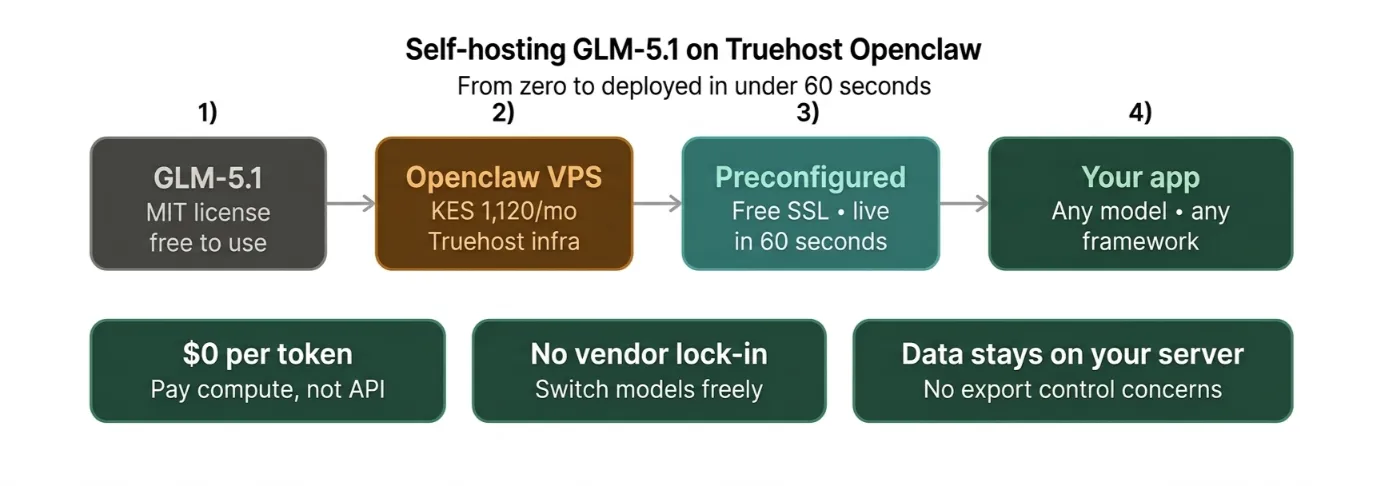
One option worth knowing is Openclaw on Truehost, which is provider-agnostic.
That means you can run GLM-5.1 today, switch to Claude Opus 4.8 via API tomorrow, or move to any future model without having to redeploy your stack.
It comes preconfigured, includes free SSL, and can go live in about 60 seconds, with pricing starting from KES 1,120 per month.
The simple rule: GLM-5.1 for value, Claude Opus 4.8 for quality.
GLM-5.1 vs Claude Opus 4.8 FAQs
What is the difference between GLM-5.1 and GLM-5?
GLM-5.1 is a refined version of GLM-5 focused on better coding and agentic performance through improved post-training. The core architecture remains the same (754B MoE, 203K context), but it scores significantly higher on SWE-Bench Pro and handles long-horizon tasks more effectively.
Does GLM-5.1 support image or multimodal inputs?
No. GLM-5.1 is text-only. For vision, image analysis, or document processing, you’ll need GLM-5V or another model. Claude Opus 4.8 supports both text and vision input.
Can GLM use MCP?
Yes. GLM-5.1 supports function calling and structured outputs, making it compatible with MCP toolchains. It scores 71.8 on MCP-Atlas, while Claude Opus 4.8 scores higher at 82.2.
What is effort control in Claude Opus 4.8, and should I use it?
Effort control lets you adjust how deeply Claude “thinks” before answering. Use Low effort for speed and High effort for complex tasks like architecture decisions or detailed analysis. Standard mode works well for most everyday work.
Can GLM-5.1 run locally?
Yes, this is one of its biggest strengths. Thanks to its MIT license, you can self-host it on Truehost OpenClaw VPS with zero per-token costs. It runs smoothly via vLLM, SGLang, or Transformers, giving you full data control.
Is ChatGPT 5.5 better than Claude Opus 4.8?
It depends on the task. Claude Opus 4.8 leads in coding quality (69.2% SWE-Bench Pro) and agentic performance. GPT-5.5 is stronger in some terminal/CLI tasks and is cheaper per token. Test both for your specific workflow.